Cups & Cubes Redux
For the second time I am presenting my award winning “Holava’s Cups and Cubes” routine re-visited (Redux). The original routine was first published in the September 1957 issue of the Linking Ring with an introduction by my friend the late Harris Solomon, Past National President of the I.B.M. The original version of the trick required the use of three 5-½-inch tall, different colored aluminum cups with curved edges and three sets of two 1-½ inch colored sponge cubes.
I was asked to perform the routine and to my dismay, I was missing one of the original cups. I could not find a source for a similar tall cup but did find a source for a smaller 3-½-inch version of the aluminum cups. I purchased the smaller version of the cups and with a little re-working of the routine, using the same size colored soft sponge cubes and adding a surprise finish, the smaller cups and the new finish add a new dimension to an old trick. You willfind that the revised routine is best performed standing which allows you better misdirection when the cups are loaded with cubes and sponge balls for the finish.
REQUIREMENTS
THREE CUPS – These are different colored spun aluminum cups that can be purchased on-line (referred to as tumblers) from www.catalogfavorites.com. The 8 oz cups are 3½-inches tall with straight-sloped sides and curved edges.
SIX SPONGE CUBES. – Nearly perfect 1-½ inch colored cubes for the Cups & Cube Routine can easily be made from foam padding and Rit all purpose tint and dye.
WHAT’S NEEDED?
Large piece of colorless 1-½ inch thick foam padding which can be purchased form most fabric store.
3 different colors of “Rit” all purpose concentrated tint and dye (the power form)
Long thin blade kitchen knife and blade sharpener
Wooden cutting board
MAKING THE COLORED CUBES – Using a sharpened kitchen knife cut a 12-inch by 12-inch section from the foam pad. When cutting the foam, keep the edge of the knife horizontal to the surface of the pad and the face of the knife as vertical as possible. Pull the knife slowly straight towards yourself with no down ward pressure. Let the blade of the knife do the cutting and make several passes with the knife until you have cut completely through the foam. Sharpening the knife blade between passes will ensure a cleaner and straighter cut.
With a fine point marking pen and ruler, outline 1-½ inch squares on one side of the 12-inch by 12-inch piece of foam. Following the same cutting technique described above cut the foam into 1-½ inch wide strips and then cut the strips into 1-½ inch cubes.
The foam cubes can easily be colored in hot water following the directions on the Rit dye package. Washing the cubes in hot water before coloring will remove marking pen lines. You need to rinse the colored cubes over and over until the rinse water is near colorless. Each set of “like” colored cubes should be stored in plastic Baggies. You will need three sets of duplicate colored 1½-inch sponge cubes.
THREE SPONGE BALLS – These are 2” round soft sponge balls available from many magic dealers. I use bright yellow sponge balls for a strong contrast to the colors of the cups and cubes.
THEORY OF THE TRICK – As you know, the standard cups and balls are performed with four small balls, the audience having knowledge of only three of these. In the cups and cubes, you will actually have five cubes in the cups at all times and later adding a sixth cubes while the audience sees only three cubes in use during the entire routine. The use of five cubes makes for unusual versatility. They stack and will not roll off the table.
NOTE – The routine is simple once you have run through it with the cups in hand. Do not try to make hard work of it – it’s much easier than the regular cups and balls. Aside from the self-working characteristics, which account for the major operation of the trick, there is a simple vanish of the sponge cubes (ala a sponge ball routine), a tip move to remove a cube from under a cup and the loading of a sponge cubes and sponge balls in the cups.
In learning the routine, YOU MUST letter and number the cups and cubes as shown in Fig. 1 (as seen from the audience side) or you will be lost in the first two moves. The trick is extremely simple AFTER you run through the routine.
All drawings are as you would see them from behind as you perform the routine. I suggest that you learn the routine with a “partner” – someone to read the moves to you. It can be done without a “partner” but it is much easier with help.
SET UP PERPARATION
Each set of cubes is a different color. For example: two red, two blue, two orange. The cups can also be different colors but have no relationship to the color of the cubes. Put one cube A in cup 1, leave cup 2 empty and one cube C in cup 3. Stack
the cups mouth up by inserting cup 2 in cup 3 and cup 1 in cup 2. Press the three cups firmly together so they will not come apart until you are ready to take them apart.
Put the three round sponge balls in your right pant pocket. Place them high up in the pocket for easy access. Finger palm cube B in your right hand and hold the stack of cups mouth up also in your right hand. The duplicate cubes A, B and C are openly held in your left hand. You are now ready to perform the Cups and Cubes Redux.
THE TRICK
1) NO SLIGHT ROUTINE – Place the three cubes held in your left hand in a row on the table from left to right; cube A, cube B and cube C. Transfer the stacked cups from your left hand to your right hand, retaining the finger palmed cube B.
With your right hand, remove the bottom cup 3 from the stack and place it mouth down in back of cube C. Remove cup 2 and place mouth down in back of cube B and place cup 1 mouth down in back of cube A. Each cup now has different colored cubes in front of it as shown in Fig. 2. You will need to retain the finger-palmed cube B throughout the next four moves.
2) Pick up cube A with your left hand and place on top of cup 1.
3) Pick up cup 2 with your right hand and place over cube A on top of cup 1, pressing down firmly. With the aid of your left hand, hold the cups together and with the right hand fingers tap the top of cups for dramatic emphasis. With your left hand, still firmly holding the cups together, lift both cups to reveal the duplicate cube A.
4) Give the two cups a half turn with the bottoms facing audience and the opening towards you. With right hand, remove bottom cup 2 (which contains a cube) and place mouth down over cube B.
5) Pick up cube A from table and place on top of cup 2. With the right hand, place cup 1 over cube A on top of cup 2
(Fig. 3). Press the cups down firmly with your left hand and tap the cups with your right fingers for dramatic emphasis.
With the left hand still holding the cups firmly together, lift both cups with the left hand to reveal a stack of two cubes A and B as shown in Figure 4.
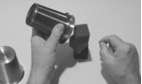
Fig. 3 Fig. 4
6) Give the two cups a half turn, bottoms facing audience and opening towards you. With right hand remove cup 1 and place mouth down to your left and place cup 2 mouth down between cups 1 and 3 (Fig. 5).
7) With right hand (still with a finger-palmed cube B) place cube C on top of cup 3. Pick up cup 2 with left hand and place over cube C on top of cup 3 and press down firmly. With the aid of your left hand, hold the cups together and with the right hand fingers, tap the top of cups for dramatic emphasis. With your left hand, still firmly holding the cups together, lift both cups to reveal a cube.
6) Give the two cups a half turn, bottoms facing audience and opening towards you. With the right hand, remove bottom cup 3 and place it mouth down in back of stacked cubes A and B. At the same time place cup 2 (which contains a cube) mouth down over the stacked cubes A and B.
Place the left hand fingers around the mouth of the cup 2, pressing cup 1 and cup 2 firmly down on the table. DO NOT REMOVE YOUR RIGHT HAND FROM CUP 2 UNTIL YOUR LEFT HAND HAS A FIRM GRIP AROUND THE TWO CUPS.
7) Pick up cube C with the right hand and place on top of cup 2.
8) Pick up cup 3 with your right hand and place over cube C on top of cup 2, pressing down firmly. With the left hand holding the two cups firmly pressed down on the table; tap the top of cups with the right hand fingers for dramatic emphasis. With your left hand, lift both cups very slowlyto reveal a stack of three cubes from top to bottom, cube C, A and B (Fig. 6).
Fig. 6 Fig. 7
9) With the two cups still in your left hand, give the cups a half turn, bottoms facing audience and opening towards you. With the right hand over the mouth of the cups, remove cup 2 and at the same time allow the finger-palmed cube B to drop into cup 2 as shown in Fig 7.
10) Place cup 2 with its mouth down in back of the stack of three cubes and place cup 3 mouths down to your right as shown in Fig 8.
11) Take cube C from the stack and put on top of Cup 3, next put cube A on top of cup 1 and put cube B on top of cup 2. Fig 9.
12) VANISHING AND LOADING THE CUBES – Pick up cube A from cup 1 with the right fingers and vanish the cube by pretending to place the cube in the left hand but actually finger palming the cube in the right hand (ala sponge ball vanish). Make a throwing motion with the left hand towards the cup and open the left hand to show the cube has vanished.
Pick up cup 1 with the left hand to reveal that the cube has reappeared back under the cup and in one continuous motion, places the cup opening into your right hand but do not let go of the cup with your left hand. It is at this moment that the finger palmed cube is allowed to drop into the cup (the same way as shown in Fig. 7) under the misdirection of the appearance of a cube. As soon as the cube drops into the cup, the left hand places the cup (with the duplicate cube inside) over the cube on the table.
13) Repeat step 12 with cubes C and B to end up with duplicate sets of cubes under each cup as shown in Fig 10.
14) THE TIP MOVE (WITH CUBE ON CUBE) – With right hand, grasp cup 1 and tilt the cup quickly with the opening towards yourself, facing your left hand. With the left hand, take the cube that is part way out of the cup as shown in Fig 11 and immediately bring the cup back down. Put the cube on top of cup. The illusion is perfect.
You are just apparently removing a cube from under a cup and placing it on top of the cup. You will find that after some practice, the cup can be tipped and lifted slightly off the table.
Repeat the tip move with the remaining two cups. At this point each cup again has a cube on top of it and a matching cube under it as shown in Fig 9 above.
15) LOADING THE SPONGE BALLS – Take cube A, hold it up to audience and deliberately place it in your right pant pocket. As your empty hand leave your pocket, finger palm one of the round sponge balls. This is made easy if the sponge balls are tucked high up in the pocket and the cube is place at the bottom of the pocket. As your right hand leaves your pocket, tap the cup with your left fingers for dramatic emphasis and pick up the cup with the left hand to reveal that the cube has reappeared back under the cup and in one continuous motion, places the cup opening into your right hand but do not let go of the cup with your left hand.
It is at this moment that the finger palmed sponge ball is allowed to drop into the cup under the misdirection of the appearance of a cube, as shown in Fig 12.
Fig. 11 Fig. 12
As soon as the sponge ball drops into the cup, the left hand places the cup (with the ball inside) over the cube on the table.
16) Repeat step 15 with cubes C and B to end up with a sponge ball on top of a cube under each cup (Fig 13).
17) TIP MOVE (WITH BALL ON CUBE) – With your right hand, grasp cup 1 and tilt cup quickly with opening towards yourself, facing your left hand leaving cube A on the table. With a little practice, the sponge ball will roll to the back of the cup allowing you to slightly lift the cup off the table.
Pick up cube A with the left hand, place the cup back down on the table and put cube A on top of cup 1. Repeat the tip move with cups 2 and 3 to end up with a cube on top and a sponge ball under each cup. Fig 14.
18) Take cube A and hold it up to the audience. Deliberately place it in your right pant or jacket pocket. Take cube B and deliberately place it in your left pant or jacket pocket. Take cube C and deliberately place it in your right pant or jacket pocket. At this point you have three cups with a single large sponge ball under each cup.
19) THE FINISH. – With the right hand, fingers tap the top of each cup for dramatic emphasis. The audience will be expecting you to produce the cubes again. Pause as if the trick is over then one at a time, left each cup to reveal a sponge ball, and the cups can be shown empty.
SUGGESTIONS AND NOTES – If you are not the type with an easy flow of language, you can do the effect to music without saying a word. You will have a beautiful piece of magic. As my friend Harris Solomon once wrote, “The cups and balls were, are, and will always be one of the great classics of our art”.